What is a story? In the simplest of terms, a story is anything told. The Oxford English Dictionary defines story as “An account of a series of events, facts, etc., given in order and with the establishing of connections between them; a narration, a story, an account” (“narrative”). When we tell a story, we are using narrative, a story told using great detail. Often when working on a large writing project, it is easy for writers/authors to feel lost and get discouraged. Overwhelmed. But not us. Because we are going to structure out story as we develop it.
Pre-writing: Thinking About Structure
When embarking on a massive writing project, it is on our best interest to have a plan in place for where the story is heading. It sounds boring to panster writers like myself, but trust me, giving yourself a framework to move within will help save time in the end. My first novel, Between Octobers, took almost four years to write. It was the first book I ever wrote. My first attempt at writing and I had no idea what I was doing. I wrote enough to fill two volumes and spent years rewriting and editing. Around 2010, writing advice was tougher to find. Every blog I found on organizing my writing kept pointing me to outlines but every time I tried to make one, to organize the chaos of my story, I’d get overwhelmed and want to quit. I felt lost.
Traditional outlines have never worked for me. Until I started looking into screenwriting. See, when you take the method for building a screenplay and apply it to whatever kind of story you’re writing– whether short story, novella, or massive, Harry-Potter-length novel– you somehow end up with a workable method of storytelling.
I will be using Save the Cat, but there are many ways to structure a story. Below are links to several popular methods:
There is also this amazing lecture, given by professor Eric Edson that lays out the three-act structure alongside the hero’s journey with great detail:
I encourage all of you to explore the above links to other structures and find the one that works best for you. Everything in the Save the Cat can be melded into other storytelling styles.
I will be using Save the Cat because it’s the structure I am most comfortable with. I really like how it breaks each section of the story into beats. A “beat” is a series of 3-5 scenes (that number s flexible) that work in tandem to move the story forward. The goal being to use every moment of your story to give the information that is needed in the moment. This helps an over-writer like me to trim away the fluff and keeps me focused. For example, if a reader needs to know something about your protagonist that is important to an upcoming plot point, then you’ll need to use a scene (or page) to illustrate that selfish behavior. It’s also useful in building, brick-by-brick, scene-by-scene, towards those wonderful moments of conflict where your plot threads converge.
Save The Cat beat sheet uses the classic three acts and gives a name for everything that needs to happen in each act:

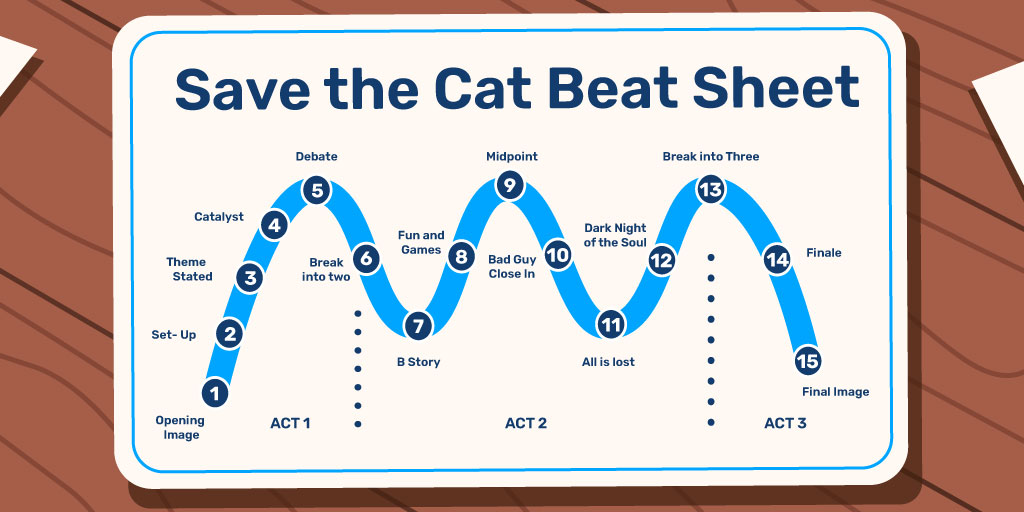
If you’ve ever read anything about story structure, you know it’s all about building tension. The obstacles your protagonist faces should get progressively difficult. You can sometimes throw a major monkey wrench all at once. That worked very well for Castaway. It threw the main character into a whole new world and the rest of the story became about survival. It started with the biggest obstacle and then broke it all down into smaller but equally important issues. Brilliant storytelling!
Structure can be important to the type of story you’re developing. Three-acts works well for most stories. Especially big ones. Epics and trilogies. Those big, sweeping tales where the whole world is in peril will thrive in this structure. But that may not be your narrative.
I encourage you to take some time and consider the story you want to write. What kind of story do you want to write? What genre? Is it science fiction? Romance? Adventure? Is it all three? Or maybe something more literary and character-driven? Familiarize yourself with the structure you think will pair well with your writing style and come back next week when we start building character with the opening image!
In the meantime, here is a geeky breakdown with helpful terminology for beginning storytellers that one of my brainy professors, for English 520 Story and Concept, put together:
“Story Geeking: terms and concepts
A. Plot: A plot is the sequence of events in the story.
Events: Think of a story you’ve enjoyed recently. What was the first thing that happened in the story? That is an “event.” A plot is the sequence (i.e., order) of events. A sequence of events doesn’t mean the timeline of events is linear.
B. Story: A story is an entire narrative.
A story requires a plot. The plot holds the story’s events. A story also includes point-of-view (POV), theme, setting, and other literary devices.
C. Structure: The story structure is the framework for the plot.
The story structure is how a writer lays out the events in the plot. Flashbacks are part of this How. So is including a page with a quote before each chapter. So are reversals. So is a prologue.
D. Plot Outline: The plot outline is the plot’s sequence of events laid out.
Story Structure vs. Plot Outline:
o A story structure dictates the baseline events. For example, a short story’s structure includes a prologue, a rise, and a fall. (this is a simplistic example)
o A plot outline decides the specifics of the structure. For example, a bullied boy (prologue) grows into a man who unexpectedly gains power and rules an entire big box company (rise). Soon after gaining this power, an enemy bully from childhood thwarts him, and his power is stolen (fall).
E. Connections: Making Sense of it All
The story is a house.
The story structure is the frame of the house.
The plot is all of the rooms defined by the frame.
Each room is an event from the plot.
The plot outline tells us each room’s use.
E. Theme
What is a Theme? Theme asks readers to reflect deeply or differently on an idea or concept. It is explained in a variety of ways. Theme is not the subject. It is the Story’s Why. The Concept. The Big Idea.”
I hope all of this has helped you learn what kind of story you want to tell. If I missed something, or if you have questions, drop them in the comments below!
Then take some time to checkout the Save The Cat website. It is overflowing with so many resources about story telling for all types of genres and writers.
 A.R. Rivera
