
It is August and students everywhere are back at school.
School means homework and studying. Both can be uber-frustrating when there are so many other things that need doing. In the spirit of learning, I thought I would throw up a quick post on how to study in a way that maximizes your ability to learn and saves time because studying is a necessary part of student-life. Even if you’re a straight-A high schooler who never cracked a book, you’ll need to know this stuff when you get to college. College courses require study and when you’re pressed for time (as you most certainly will be) you’ll need to know the best methods of study to get and keep yourself on a studious path.
The best way to study is make the most of your time. In order to do that, you must know how you learn. Do you learn best by hearing, by reading, writing? If you’re not sure, click the link to answer the VARK test questions. It’s only five or six questions to help determine your best methods of learning. Here’s a snapshot of my own results:

Visual learners are just what they sound like: people who learn by seeing/watching a demonstration. Kinesthetic learners are people that learn by doing. They are hands-on, physically moving. Aural means you learn best through sound. You can remember what someone said better than what you read. Reading/Writing learners is pretty self-explanatory.
As a multimodal learner, when I had a challenging subject (like statistics or physiology), I would always record the class lecture, and copy the notes the professor had on slides or white board during class. Then, when I sat down to study, I would listen to that days lecture again and take notes a second time. Then, I would do the assigned reading and make flashcards based on terminology and lecture notes. So I heard the lecture twice and wrote down the information I needed to learn three times. By committing to that extensive type of study, I passed my toughest subjects with an ‘A.’
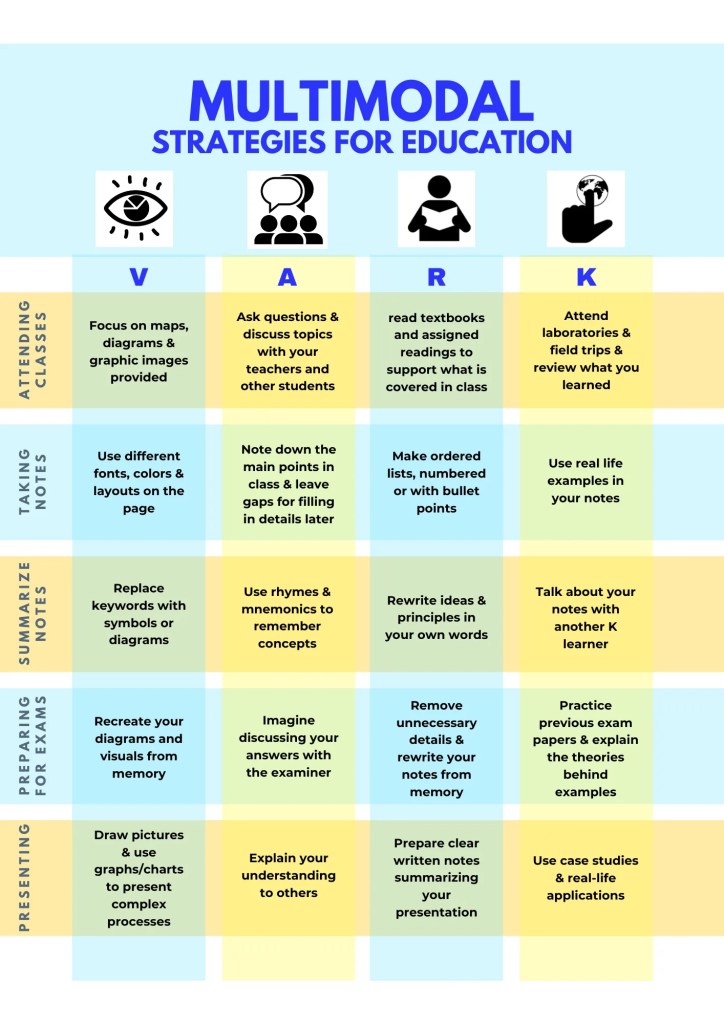
Methods For Each Type of Learner
- Visual: You love charts, graphs, and visual aids. Highlighting and diagramming will work for you. Try making flashcards or slides with pictures. You can also watch videos and glean information.
- Aural: Listening is your strength. So is self-talk. If you have assigned reading to cover, read aloud. Record lectures and listen to them again after class. Repeat information to yourself, or better yet, explain or discuss the concept to someone who knows nothing about it. If you can’t find anyone, then explain it to yourself out-loud.
- Read/Write: Read the assigned text more than once. Take notes during class and read them again later. Use a highlighter. Make flashcards.
- Kinesthetic: You must apply something physical to your learning process. The most immediate way is writing by hand. When you take notes, use a pen and paper, not a keyboard. Make physical flashcards instead of slides. Buy the physical book and highlight the sections your teacher spends the most time talking about. Digital media is pretty, but in making a physical representation with your own two hands, you will learn a lot more.
Understanding how you learn is key to maximizing your learning power. By applying the methods of study that appeal to your specific learning style, you are increasing your chances of success!
That’s all for now.
Did you take the VARK Quiz? What ways help you learn the best?
 A.R. Rivera