
Because this is the type of stuff you write when you’re in a graduate program…
George R. R. Martin is the author of the successful fantasy series, A Song of Ice And Fire, which was adapted into the cultural phenomenon known as the HBO series, “Game Of Thrones.” Within the three books to be analyzed (A Game Of Thrones, A Clash Of Kings, A Storm Of Swords, And A Feast For Crows), Martin’s stories are complex, detailed and epic in expanse. The author builds a detailed world with archaic politics, sexism, and conflicting ideologies amid an ensemble cast of characters, all while adhering to a strict third-person narrative. The excess of detailed lineage and kingdom histories (replete with maps and detailed character and kingdom backstories) employs the use of several linguistic elements that inspire and refine his violent tales into the masterworks of fiction enjoyed by readers all over the world. George R. R. Martin’s writing engages readers with a clearly defined, bare-bones functionality that uses not only archaic diction, but synonymy and antonymy, semantic shifts, and varying registers with an impressive cohesion across the series which works together to reinforce his simplified writing style.
When one thinks of Game Of Thrones, the topic of sexism automatically arises. As it did for Nicolangelo Becce, author of Adapting George R. R. Martin’s A Game of Thrones: a Corpus Linguistics Analysis from a Gender Perspective. Becce considers Martin’s series positively “medieval,” with linguistic inequities running rampant in every medium used to retell the story (p. 94). One example of this, he states, is the “the predominance of the word “please”” used by one of the main characters, Sansa Stark. He believes that the frequent use of this term qualifies the character to a “submissive role as a stereotypical princess” (p. 92). However, Becce’s article focuses mainly on the adapted TV series (as most scholarly articles are) rather than the language within the novels themselves. Although, it must be said that within Martin’s medieval fantasy world, chauvinism is alive and well, just as it is in the real world. The focus of this paper is to examine the language and general societal interactions used specifically in the novels, from a linguistic perspective.
The first thing a reader learns about Martin’s archaic fantasy is that the common language the characters use is, on average, at least three hundred years old. Even so, the diction seamlessly draws readers into his ancient world of castles, dragons, and guillotines. For instance, terms like “elsewise” (A Feast For Crows, p. 2742) could hardly be found in any story set in modern times:

The Online Etymology Dictionary defines “elsewise” is an adjective from the 1540’s which means, “in a different manner, otherwise.” He also has characters using the word “without,” (Game of Thrones, p. 134), in the old English meaning “outside [the wall]” (OED):
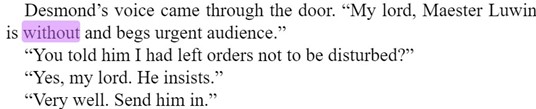
Each term is used in a context that provides a reader with the ability to decipher the older meaning, thus enriching the reading experience without disruption.
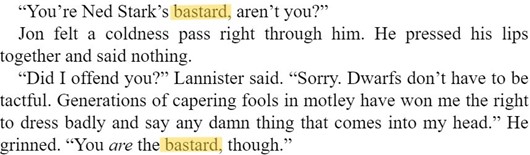
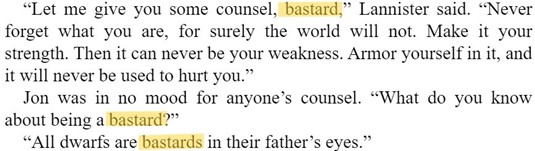
The societal structure within the series is monarchal, with a strongly enforced caste system. Those with titles are high born; educated knights, Lords, and Wardens, governing the low-born common people. The lowest of the low-born are the bastards. According to the Oxford English Dictionary (OED), the term was coined in 1330, as one “of abuse or contempt for a person (esp. a man or boy),” referring to “a person conceived and born out of wedlock; an illegitimate child.” Within the Game of Thrones novel, the term is slung at one of the series’ most beloved characters, Jon Snow. He is the illegitimate son of a Lord that holds the respected position of Warden of the North. Yet Jon is a social pariah. He is not permitted to sit near his family when the king comes to visit. It is not only through action that Martin places great emphasis on the importance of one’s rank by birth. He also uses repetition:
(A Game Of Thrones, Martin, pp. 118-19)
In just a few paragraphs, the insult is repeated five times for emphasis. According to How English Works, by Anne Curzan, this kind of repetition is called lexical cohesion, because it “ties parts of a text to one another” through “repetition of words across sentences” (p. 282). This illustrates to readers that even though Jon Snow is a member of a high-born family, he is still illegitimate. Although most readers will not agree with the stigma, the character’s struggles are easily understood, and add another layer of conflict to the story.
As a reader follows the journey of Jon Snow through the series, there are more notable linguistic elements employed that build an effective cohesion. Such as synonymy and antonymy, by application of a semantic shift to the insult constantly directed at Jon Snow. After he leaves home to train for (what he thinks is) an honorable career path, Jon is mockingly nicknamed “Lord Snow” by his trainers. “Jon hated the nickname, a mockery that Ser Alliser had hung on him the first day he came to practice” (p. 310). Martin uses context to clearly define this semantic shift. Lord becomes a synonym for bastard even though the title, Lord, is closer to a gradable antonym (Curzan, p. 216).
The high-born characters also speak differently than the characters of lower birth. A sort of dialect ruled by rank rather than region. For instance, a low born character, when addressing a person of status, will use a contraction of a formal address, “m’Lord” (A Clash Of Kings, Martin. p.2140), rather than my Lord. When any high-born Lord addresses their peers, they use the two separate words, “my Lord” (A Feast For Crows, p. 2981) This small detail is found in numerous places throughout the books, where members of different social castes interact. The only time the title changes is when a member of the royal family is addressed. The title still shows possession and rank, but it changes to “your Grace” (or his/her Grace respectively) (A Clash Of Kings, Martin, p. 1982).
The author’s use of language consistently provides the reader with a linguistic equality, in the sense that “all varieties are equally rule-governed and logical, as well as responsive to [the] speakers’ needs” (Curzan p. 370). Each character knows how to get their message across and has no trouble finding the words to do so. It is their word choice, their diction, which is unequal, because having titles determine one’s access to education. Inequality requires each character to use a formal register when addressing or referencing a person considered socially superior.

In the short excerpt from page 713 of A Game Of Thrones, Martin uses three titles of varying social standing. “The steward” is addressed by his position as a servant, without a proper title. Then “His Grace,” “my Lord,” and “the Queen,” are also used. This is a meeting where three different levels of the social hierarchy are in attendance. Their titles not only convey a message of identification but also reinforce the expectations of the caste system.
There is also a notable change in register between the speakers in the above excerpt. Ned is an honored man, a Lord, acting as the “Hand of the King,” which makes him the second most powerful man in the realm. Notice his casual register as he addresses his underling, using a contraction. “You’ve done well, Alyn.” But when the Steward addresses his Lord, Ned Stark, he bows low and uses a formal register, absent of contractions.
Much of Martin’s work is streamlined using linguistic devices. However, to be sure that his clean, minimalist style is more than a matter of opinion, one should examine the series’ lexical density as well as its readability. According to Victoria Johanneson’s article, Lexical Density In Speech And Writing: a developmental perspective, “Lexical density is the term most often used for describing the proportion of content words (nouns, verbs, adjectives, and often also adverbs) to the total number of words” in a piece of literature. A Game of Thrones has a score between 4 and 4.5, which is quite low, compared to the first Harry Potter book, which has a lexical density score between 8 and 4.8. The readability factor is determined by the Automated Readability Index (ARI), whose general purpose is to align a specific school grade reading level. The ARI score for A Game of Thrones is sixth-grade, or 11-12 years old (medium.com). These combined scores tell us that A Game of Thrones is accessible to most readers. It carries an excess of content and complicated plot yet remains easy to read and understand because of the author’s clean, efficient writing style.
Whether diction, registers, semantics, or synonymy and antonymy, each of these linguistic elements helps provide an exciting, cohesive story for the reader. After examining the linguistic elements Martin employs, it is clear how the author uses them to refine his writing, making the stories feel ancient and realistic though they are thirty-year-old fantasy. A change in diction is used to transport a reader back in time. Semantic shifts combined with synonymy and antonymy illustrate exclusion and oppression. A single change in register reinforces an archaic social construct. All these linguistic elements create believable characters in a complex tale that is simply put together. Martin has created an ancient, complex society, whose structure relies on a strict social order that influences every aspect of his characters’ lives, and, in turn, the language they use. All, while remaining accessible to readers the world over.
Source Material:
“Bastard.” Oxford English Dictionary. Oxford University Press. July 2023. https://www.oed.com/dictionary/bastard_n?tab=meaning_and_use#26393178
Becce, N. “Adapting George R. R. Martin’s A Game of Thrones. A Corpus Linguistics Analysis.” Anglistica AION. Volume 22, Issue 2. 2022 (92, 94).
Curzan, Anne, and Michael P. Adams. How English Works (3rd Edition). Pearson Education (US), 2014.
“Elsewise” Online Etymology Dictionary. Web. Accessed 1 Aug 2023. https://www.etymonline.com/search?q=elsewise
Johansson, Victoria. “Lexical Diversity And Lexical Density in Speech And Writing: a Developmental Perspective.” Lund University, Dept. Of Linguistics and Phonetics. Volume 53. 2008. (p. 65).
Martin, George. A Feast For Crows. Bantam Books. 2005. eBook.
Martin, George. A Clash Of Kings. Bantam Books. 1998. eBook.
Martin, George. A Storm Of Swords. Bantam Books. 2000. eBook.
Martin, George. A Game Of Thrones. Bantam Books. 1996. eBook.
Spathis, Dimitris. “Exploring Linguistic Patters In Best-Selling Book Series.” Medium.com. 29 March 2015. Web Access 18 August 2023. https://medium.com/@dimitrisspathis/exploring-linguistic-patterns-in-best-selling-book-series-100290c94242
“Without, adv., sense 1”. Oxford English Dictionary. Oxford University Press. April 2023. https://doi.org/10.1093/OED/1335565371
 A.R. Rivera